
The healthcare industry is evolving rapidly, and at the heart of this transformation is technology. From artificial intelligence and real-time tracking to temperature monitoring and digital inventory systems, innovation is reshaping the way medical products move through the healthcare supply chain.
Medical deliveries are no longer simply about transporting products from one location to another. Today, healthcare logistics is driven by precision, visibility, speed, and data. Every shipment must be tracked, monitored, and managed to ensure that medicines, vaccines, laboratory samples, and clinical trial materials arrive safely, on time, and in the right condition.
Technology is making this possible.
One of the most significant advancements in healthcare logistics is real-time shipment tracking. Healthcare providers, sponsors, laboratories, and research institutions can now monitor the location of critical shipments throughout their journey. This increased visibility allows logistics teams to identify potential delays early, respond proactively to disruptions, and provide greater transparency to clients.
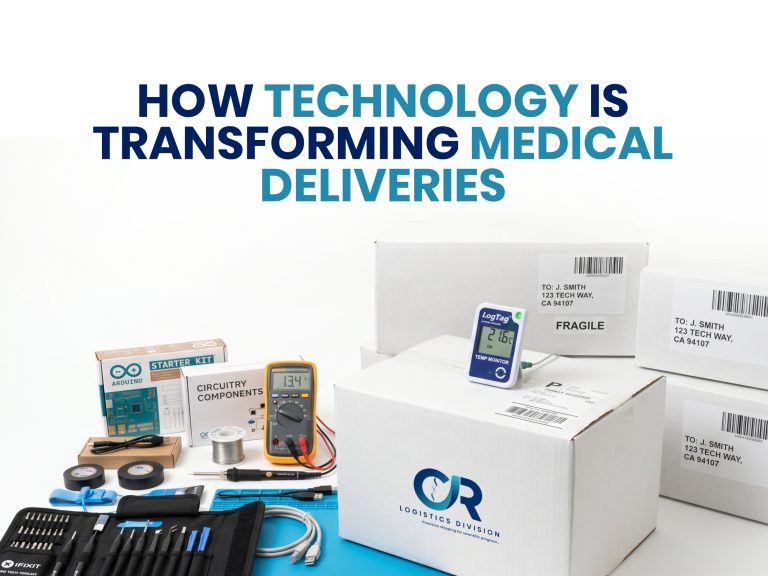
Another game-changer is temperature monitoring technology. Many healthcare products—including vaccines, biologics, blood products, and investigational medicinal products (IMPs)—must remain within strict temperature ranges to preserve their quality and effectiveness. Digital temperature sensors and data loggers provide continuous monitoring throughout transportation, helping ensure that cold chain requirements are maintained from origin to destination.
Technology has also transformed inventory and warehouse management. Automated inventory systems help organizations maintain accurate stock levels, reduce waste, improve forecasting, and ensure that essential medical supplies are available when and where they are needed. Barcode scanning and RFID technology further enhance traceability by allowing products to be tracked at every stage of the supply chain.
In clinical research, these technological advancements are particularly valuable. The transportation of investigational products, biological samples, and laboratory specimens requires meticulous coordination and strict regulatory compliance. Digital systems help maintain chain-of-custody records, improve documentation accuracy, and provide the visibility needed to support high-quality clinical trials.
Artificial intelligence and predictive analytics are also beginning to influence healthcare logistics. By analyzing transportation patterns, weather conditions, traffic, and demand trends, these technologies can help optimize delivery routes, anticipate disruptions, and improve operational efficiency. This means faster deliveries, lower costs, and a more resilient supply chain.
For healthcare organizations, adopting technology is no longer just about improving efficiency—it is about enhancing patient safety. Every innovation that strengthens shipment visibility, protects product integrity, and improves compliance contributes to better healthcare outcomes for the patients who ultimately rely on these products.
At Clinique Logistics, we recognize that technology is a powerful enabler of quality healthcare logistics. By embracing modern logistics solutions and continuously improving our processes, we strive to deliver healthcare products with the precision, transparency, and reliability that today’s healthcare and clinical research sectors demand.
As healthcare continues to evolve, so too must the systems that support it. Technology is not replacing the human expertise behind healthcare logistics—it is empowering logistics professionals to work smarter, respond faster, and deliver with greater confidence.
The future of medical deliveries is already here, and it is smarter, safer, more connected, and more efficient than ever before.
📖 Read the full article on the Clinique Research Blog to discover how technology is transforming healthcare logistics and why innovation is essential to the future of medical deliveries.
💬 Let’s discuss!
Which technological advancement do you believe will have the greatest impact on healthcare logistics over the next decade?
Is it artificial intelligence, real-time shipment tracking, Internet of Things (IoT) sensors, drone deliveries, predictive analytics, blockchain, or something else?
Share your thoughts in the comments—we’d love to hear your perspective.